
Cultural landscape classification of Bavaria, significant cultural landscapes in Bavaria and cultural landscape guiding principles for Bavaria
Background
The accelerated change of Central European cultural landscapes in recent decades is not only leading to a considerable loss of the diversity of species and habitats created by cultural history, but also to a blurring of characteristic regional features.
For some years, cultural landscapes have therefore received increased attention in science and spatial planning, in politics and among the public. Cultural landscapes are not only of great importance for Bavaria’s declared environmental policy goals of sustainable development and the conservation of biodiversity. They are also part of Europe’s natural and cultural heritage, contribute to human well-being and are closely linked to spatial perceptions and a sense of home. Although there is a legal mandate to preserve and develop cultural landscapes, their consideration in comprehensive spatial planning has so far been unsatisfactory.
Project objective
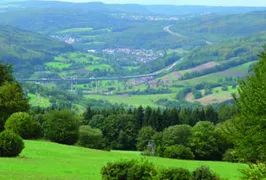
The aims of the three projects are:
- to develop a comprehensive classification of Bavaria into cultural landscape areas that are as homogeneous as possible and differ from other areas in their cultural landscape character because of their individual distinctiveness
The characteristic distinctiveness of each landscape was identified using a uniform system and described in cultural landscape profiles. The cultural landscape classification of Bavaria and the characterisation of the 61 delimited cultural landscape areas are intended to contribute to the sustainable development of Bavaria’s diverse landscape as a source of biodiversity and as a space of identification for the population. - to identify significant cultural landscapes
The task of this project was to identify cultural landscapes of particular value in Bavaria. “Significant cultural landscapes” were understood as landscape sections or sub-areas whose appearance is largely shaped by historical and traditional influences and which have thus preserved a natural and cultural distinctiveness that is exceptional on a statewide scale. - to develop cultural landscape recommendations for the cultural landscape areas in Bavaria
This project formulates recommendations for safeguarding and developing the historically evolved distinctiveness of cultural landscapes. They provide guidance and recommendations for preserving Bavaria’s diverse cultural landscapes and show perspectives for their further development in planning and other landscape-related decision-making processes. The recommendations refer to the 61 cultural landscape areas developed in the first project.
First results of the cultural landscape classification of Bavaria were published by the LfU in January 2013 (in German).
Project partners and duration
The project is carried out in cooperation with the Institute of Landscape Architecture of the Weihenstephan State Research Institute for Horticulture (FGW), which leads the project. It was commissioned by the Bavarian Environment Agency and, for the third sub-project, also by the Supreme Building Authority in the Bavarian State Ministry of the Interior. The research project is scheduled to run from September 2009 to October 2013.