
News

21/11/2025 - New Spanish-Language Reference on Forest Growth Released by Our Team
The adaptation of the renowned "Grundlagen der Waldwachstumsforschung" by Hans Pretzsch is now available for the Spanish-speaking community*
*first book published in Spanish by Springer Nature
Crecimiento y producción forestales (Forest Growth and Yield) presents a clear and comprehensive overview of how European forests grow and produce, written by Hans Pretzsch, Miren del Río, Astor Toraño-Caicoya, and Gregorio Montero. The book brings together the essential foundations of forest dynamics with the most up-to-date scientific knowledge, explained in a practical and direct way. Written entirely in Spanish, it makes this field’s core knowledge accessible to the wide Spanish-speaking academic and professional community. Each chapter ends with key take-home messages, and more than 400 figures support the understanding of concepts and examples. Based on Pretzsch’s renowned German edition, this version has been revised and expanded to cover different climatic regions and to offer a broader international perspective. It is a solid and highly didactic reference for students, professionals, and forest managers looking for a reliable and modern resource on forest growth and production. Link

31/10/2025 - What We Learned From a 150-Year-Old Thinning Experiment About Growth and Epigenetic Stability
A new collaborative study between our chair and the Professorship of Plant Epigenomics at TUM has just been published in Nature Communications
The work takes advantage of the historic Fabrikschleichach 15 (FAB15) experiment, one of the world’s oldest continuously monitored forest trials, established in 1871, to investigate how lifelong growth conditions influence developmental and epigenetic processes in trees. Because FAB15 provides trees of identical age but contrasting growth histories resulting from 150 years of different thinning intensities, we were able to isolate how growth rate affects somatic epimutation rates in trees. Wood-anatomical analyses confirmed that heavily thinned trees experienced sustained growth acceleration, producing more and larger xylem cells per year. By combining these insights with whole-genome DNA methylation profiling, we were able to show that faster growth is associated with a higher rate of somatic epimutations throughout the tree. This finding provides rare empirical support for a “mitotic-rate hypothesis,” which proposes that slower growth helps long-lived species maintain epigenetic stability over centuries. The study highlights how forest management can influence not only tree architecture and wood formation, but also the pace of molecular change inside long-lived organisms. Link
Big thanks to Prof. Frank Johannes and Ming Zhou from the Professorship of Plant Epigenomics for the great collaboration (https://www.johanneslab.org/)!

14/05/2025 - Start of the TUMmesa experiment
How climate chambers at TUMmesa help decode tree survival strategies
European beech, the backbone of Central European forests, is under pressure. As droughts become more frequent and severe, scientists at the TUMmesa phytochambers are digging deeper into how these iconic trees cope with water stress. Led by PhD researcher Gerhard Schmied, the experiment explores two key forces behind drought stress: dry soils and dry air. Which hits trees harder, a thirsty root zone or a parched atmosphere? And does soil type change the story? To find out, six high-tech climate chambers simulate precise drought conditions by manipulating vapor pressure deficit (VPD) and soil moisture across different soil textures. It's a unique setup where the atmosphere and underground conditions can be disentangled like never before. Armed with high-resolution dendrometers to track stem growth and new optical sensors for leaf water status, the team is monitoring how trees respond in real time. They're also taking a molecular look, probing wood anatomy, gene expression, and even epigenetic changes as the stress unfolds. The goal? To better understand the tipping points that lead to drought-induced tree dieback, and to pave the way for early-warning biomarkers that could protect our forests in a warming world.
02/01/2025 - New publication in Ecological Indicators
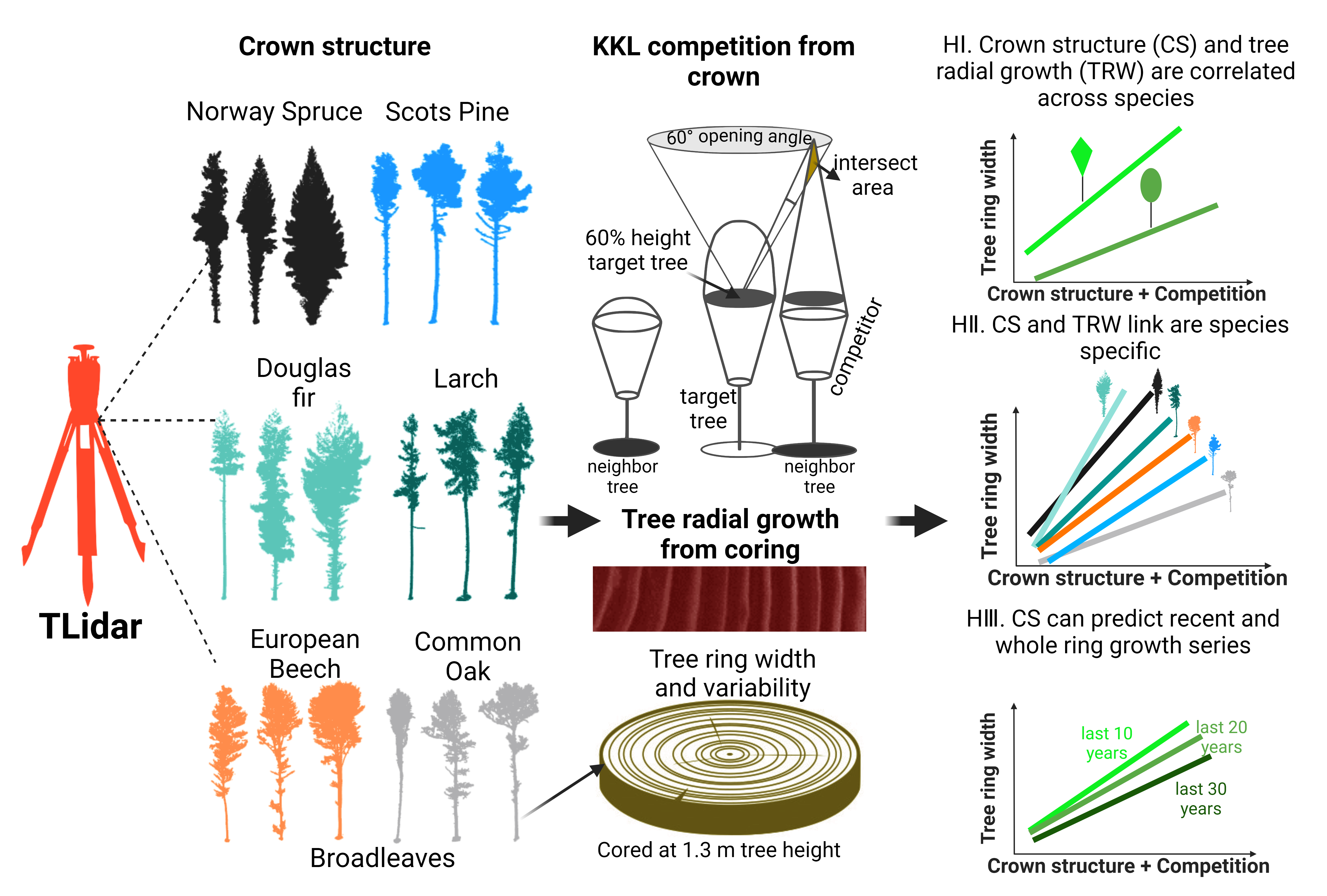
We are thrilled to announce that Shamim Ahmed has led a remarkable new publication in Ecological Indicators, titled: “Crown structure indicates tree secondary growth, competition legacy, and growth potential of dominant species in Europe.” This study explores the intricate relationship between tree crown structure and secondary growth patterns across six dominant European tree species, leveraging cutting-edge 3D terrestrial laser scanning and tree ring data. The research underscores the ecological and functional importance of crown architecture in understanding tree adaptation and guiding sustainable forest management. Shamim's work elegantly demonstrates the potential of non-destructive crown analysis to enhance growth models and tackle climate challenges, especially for species with stable growth strategies. These findings represent a significant step forward in forest ecology, paving the way for sustainable and precision forestry practices. Congratulations to Shamim on this outstanding achievement! Link
01/09/2024 - Start of the Tree Growth and Wood Physiology Group
The new Professorship of Tree Growth and Wood Physiology, effective from September 1st 2024, focuses on studying tree growth and their responses to climate change, from individual trees to entire forest stands. Our research aims to understand the mechanisms that govern tree and forest stand growth, as well as wood physiological processes, which are essential for explaining forest resilience to changing environmental conditions and their role in the global carbon budget. To advance this field, our research group employs a unique combination of innovative sensor technologies at the tree level with sub-hourly resolution, along with forest inventory data, tree ring analysis, and quantitative wood anatomy. Our findings will provide crucial insights for science-based forest management decisions and conservation actions, aimed at enhancing forest ecosystem resilience to climate change.