
Fieldwork for Future - CampusAckerdemie Weihenstephan 2022

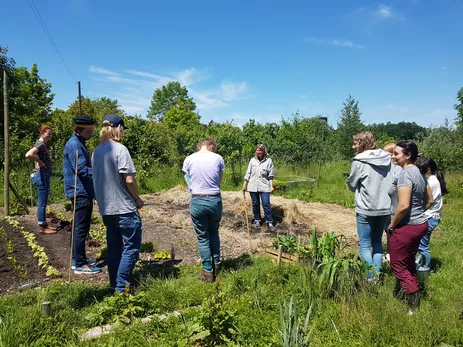
A central task of universities is to train the next generation of scientists, practitioners and multipliers who, based on scientifically sound knowledge and methods, actively contribute to addressing global challenges such as climate change, biodiversity loss and the transformation of food systems. Community gardens of various kinds, including especially school and campus gardens, are growing in popularity, and there is also increasing scientific interest in their properties as multifunctional green spaces with potential for transformative learning and practical adaptation to the impacts of climate change.
Education for Sustainable Development in Campus Gardens
In the "CampusAckerdemie" offered for the first time in the summer semester of 2022, students from both universities at the Weihenstephan campus were able to learn together how the approach of education for sustainable development [ESD] can be implemented in the context of a garden for learning and teaching. From the practical acquisition of skills in ecological gardening to getting to know didactic methods for critical nutrition education. The practical seminar was coordinated by the TUM Professorship of Urban Productive Ecosystems (UPE, Prof. Dr. Monika Egerer) and implemented in collaboration with the newly established TUM Green Office Weihenstephan, the HSWT Faculty of Horticulture and Food Technology (Prof. Dr. Hannus), as well as through the hands-on initiative of students at the campus garden "Knosporus". There, students and employees of the Weihenstephan-Triesdorf University of Applied Sciences and the Technical University of Munich work together to garden and design. In the open field and in the foil tunnel, mainly vegetables are grown in the most ecological and sustainable way possible, and the community garden sees itself as an open meeting space and a living laboratory for the growth of vegetables as well as for ideas. A suitable place, therefore, for a practical seminar that aims to enable students of different study contexts from the fields of land use to food management to understand themselves on their professional paths in cooperation with various actors in a role as effective multipliers for sustainable development.
A pilot project "with heart & spade"
The CampusAckerdemie is a pilot project of the young social enterprise "Acker e.V." in which 11 universities across Germany participated this summer. Acker e.V. works with the goal to increase the appreciation for food in society and to counteract the loss of knowledge and competence in the area of food production, unhealthy nutrition and food waste. The CampusAckerdemie pilot project aims to integrate the topic of education for sustainable development (ESD) into the training of future teachers and educators - in the case of the Weihenstephan students: future professionals and researchers from the fields of land use to food management.
While cultivating, caring for and utilizing various vegetables in the campus garden, the participants in the CampusAckerdemie acquire basic horticultural and pedagogical skills to be able to independently create a garden as multipliers and use it for educational purposes.
Primarily through practice, supplemented an extensive digital learning platform of Acker e.V. and (online) workshops. In addition to practical impulses on the approach of "Inquiry-based Learning" by the responsible professor Monika Egerer, the seminar was led by the AckerCoach and graduate geographer Ruth Mahla, who focuses her own work in adult education around the soil as a living ecosystem and is active, among other things, at the Munich "StadtAcker" - an initiative of the Ackermannbogen e.V.". The thematic focus of the seminar included the basics of organic horticulture, soil fertility and management, pest and pollinator management, and methods of education for sustainable development. The practical lessons in the teaching and learning garden were based on experiential learning, with a practical and theoretical exploration of a community garden in its capacity as a multifunctional green space and socio-ecological system to be experienced. The visit of a 5th grade class at a secondary school in Garching, which participates with its dedicated teacher in the ESD school program "GemüseAckerdemie", which has been in existence for some time, formed the content-related conclusion of the seminar. By gardening together with the children, the students were able to experience in practice how ESD can be implemented at a school in an educational garden - so that the coming generation can once again "know what they are eating" and develop knowledge and appreciation for our environment.
From Pilot project to Living Lab?
Following these pilot experiences, we believe the ESD approach of integrating campus gardens into university education as interdisciplinary learning spaces is leading the way and specifically fosters students' leadership, communication, project management, and research skills. Looking to the future, we are also currently evaluating ways to transform the current interdisciplinary ESD seminar into a transdisciplinary Sustainable Living Lab. This is an approach that allows students to work beyond campus boundaries to collaborate with local stakeholders on sustainable ideas and thus directly shape the social-ecological transformation