
Impact of Beaver Dams on Habitat Conditions and Ecological Communities in Bavarian Streams (Beaver-Project)
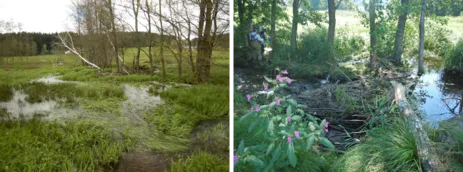
By building dams and lodges, the beaver (Castor fiber) actively shapes its habitats and is therefore often referred to as an “ecosystem engineer.” After its eradication in the 19th century, the beaver population in Bavaria has recovered well following reintroduction efforts between the 1960s and 1980s. The current population is estimated at around 25,000 animals in approximately 7,500 territories. As a result of the structural modifications created by beavers, both positive and negative hydrological and physical changes can occur in water bodies.
The aim of the project is a comprehensive investigation of the impacts of beaver dams on third-order streams, with regard to changes in habitat characteristics and the associated communities of fish, lampreys, and macroinvertebrates (mussels, crayfish, small aquatic organisms). Particular attention will be paid to influences on the temperature regime and sediment dynamics, as well as the resulting altered conditions for salmonids and threatened small fish / Habitats Directive species such as the spirlin (Alburnoides bipunctatus) and the bullhead (Cottus gobio). This includes examining fish and lamprey populations, the quality of gravel spawning grounds, stream connectivity, and the food availability for the target species.
By integrating multivariate information on habitat quality and the composition of various aquatic communities, the effects of beaver dams can be captured and condensed across multiple organizational levels, enabling a holistic assessment of their impacts on the lotic ecosystem. Based on these findings, and in cooperation with the fisheries advisory services of all Bavarian administrative districts, management recommendations for beaver management — particularly in small streams — will be developed.
