
Research direction, strategic development and data mining: Dr. Steffen A. Schweizer (steffen.schweizer@tum.de)
Team management, capacity building, and analytical coordination: Dr. Carmen Hoeschen (carmen.hoeschen@tum.de)
🔬🤝Strengthening interdisciplinary collaboration at the TUM School of Life Sciences through high‑resolution ion mass spectrometry
We are grateful for the support of all three departments, which made the NanoSIMS Synergy Month possible. Together with an outstanding group of participants from different groups at the School of Life Science, we explored a remarkable diversity of samples and expanded the range of NanoSIMS applications, from biochar, roots, and major crops to gut microbiomes, cheese, and lake nitrifiers.
By bringing together expertise from different disciplines, the Synergy Month demonstrated the potential of NanoSIMS to reveal how life-science processes are broadly driven by microorganisms and their molecular components. Understanding where these processes occur, how intensively they take place, and how they interact with their surrounding environment is essential for advancing research in environmental and ecological sciences.
The diversity of samples and scientific questions explored during the Synergy Month highlights the versatility of NanoSIMS and the value of collaborative approaches in addressing complex environmental challenges.
Expanding the Scope of NanoSIMS in Life Sciences
Building on the progress achieved so far, we provide an overview of the diverse range of new samples analyzed using NanoSIMS:

Investigating lauric acid incorporation in Enterocloster spp. at single-cell level
Dr. Alessandra Riva, Chair of Nutrition and Immunology
The application of NanoSIMS enabled us to visualize individual cells of the gut model bacterium Enterocloster spp. and investigate its cross-feeding behavior at the single-cell level. These results open new opportunities to identify which bacterial taxa respond directly to specific carbon compounds and to explore how they interact with Enterocloster within the gut microbial community. Building on these findings, further collaboration and a joint grant proposal are planned.

Subcellular mapping of drug-induced mitochondrial remodeling using NanoSIMS
Tina Krammel, Chair of Nutrition and Immunology
In this project, NanoSIMS helped demonstrate the effects of different mitochondria-targeted compounds on mitochondrial biogenesis at the elemental level. The NanoSIMS measurements provided complementary evidence to molecular analyses and helped reveal how mitochondria-targeted drugs modulate mitochondrial function.
A key part of the project was also the optimization of sample preparation for the cells and isolated organelles, establishing a robust workflow for future applications. This provides a platform for investigating spatially resolved metabolic and elemental changes in response to pharmacological interventions and may contribute to a more comprehensive understanding of cellular adaptation to mitochondria-targeted therapies.

Lake nitrification under increasing temperature
Luciana Almeida, Chair of Microbial Physiology
CARD-FISH was successfully coupled with NanoSIMS to quantify ammonium-derived 15N uptake at the single-cell level in Nitrososphaera viennensis, an important nitrifier in lake ecosystems. This work validated a combined workflow for linking microbial identity with quantitative nitrogen uptake, providing new opportunities to investigate nitrogen cycling in environmental microorganisms at the single-cell level in aquatic ecosystems.

Distinguishing Leaf Nitrogen Pools Using 15N Labelling
Xiaoxin Song, Precision Agriculture
This project involved sectioning plant tissue, carried out in close collaboration with other participants of the NanoSIMS Synergy Month. Sample preparation is still being further optimized to improve the quality and consistency of the sections. The project aims to investigate the spatial distribution of structural and metabolic nitrogen pools across distinct plant compartments. Data analysis is currently ongoing.
Further project updates will be shared soon. Stay tuned for more!
Behind the scenes: Sample preparation workshop


The workshop introduced the basic functionality of NanoSIMS, highlighting its capabilities and limitations. A particular focus was placed on sample preparation, where we discussed critical steps and different preparation strategies tailored to the specific sample topography and stringent vacuum requirements of NanoSIMS.
To foster collaboration and knowledge exchange, participants also presented their projects to the group, providing an opportunity to discuss specific challenges, share experiences, and identify connections and potential synergies with other participants.
Individual measurements


Each project and sample had its own specific requirements and was measured individually in the NanoSIMS laboratory. A preliminary data analysis and quality check of the raw data were performed directly in the laboratory to ensure reliable measurements and identify potential issues at an early stage. The project also fostered cross-disciplinary exchange among participants, providing opportunities to share and apply different sample preparation strategies and develop novel approaches tailored to their individual research questions.


Data analysis workshop
The data analysis workshop provided an opportunity for all participants to reflect on their progress, discuss challenges encountered during sample preparation and measurements, and explore new approaches for future experiments. Different strategies for NanoSIMS data analysis were demonstrated, including further machine-learning-based approaches. These methods enabled participants to move beyond visualizing NanoSIMS images toward quantifying spatial patterns and extracting quantitative data that can be directly linked to specific scientific hypotheses.
Call for applications (archived)
Microorganisms play a central role in enabling and modulating key life science processes. Even in systems not primarily driven by microbial activity, such as photosynthesis or neural signaling, microbial-scale interactions exert a decisive influence. To advance our mechanistic understanding of these processes, it is essential to investigate functional hotspots at the microbial scale. These hotspots include root nodules, pathogen infection sites, biofilms, polymer interfaces, microplastic binding zones, and microscale regions within functional brain or kidney cells, drug release sites within tissues and many more. In each of these examples, critical biological functions depend on localized phenomena, such as the growth of a hypha into a plant host, morphological changes in cancer cells, or the precise location of drug action within tissue. Unraveling the dynamics at these microscale interfaces is key to unlocking deeper insights into life science processes.
Exemplary measurements at different scales
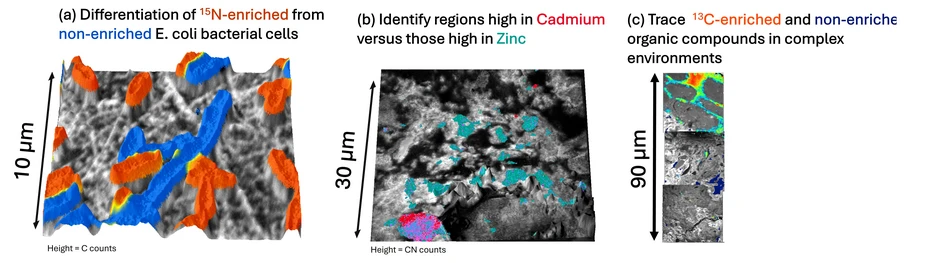
With this call, we invite research groups of the TUM School of Life Sciences to apply for participation in the NanoSIMS Synergy Month. This new initiative is aimed at strengthening interdisciplinary collaboration and advancing the One Health framework through high-resolution ion mass spectrometry. Based on the selection criteria listed below, selected projects will receive dedicated measurement days at the NanoSIMS laboratory, enabling in-depth analysis of microbial and biochemical hotspots in biological tissues and emerging materials. The application requires participation in the mandatory workshop program (one half-day pre-measurement and one post-measurement workshop). Only user groups that commit to disseminating the generated project results are eligible. Measurement days will be awarded on a first come, first served basis every two weeks until the application deadline.
We welcome proposals from all disciplines within the School that seek to explore microscale processes and contribute to a mechanistic understanding across human, animal, plant, and ecosystem health.
Got a cool project idea? Get in touch early!: If you believe your project could be a good fit, please contact us as soon as possible. We evaluate proposals on a rolling basis, so there's no need to wait until the final deadline. Early contact allows time to clarify details and begin sample preparation without delay. Further information is also available here: Technical information, sample preparation, and terms of use.
Final submission deadline: 15 February 2026
Total availability: 25 measurement days for about 5 different research projects
Eligibility: Research groups affiliated with the TUM School of Life Sciences
The proposal should provide a summary of the proposed research application including resources and planned steps of sample preparation and data analysis (max. 3 pages). In addition, the number of required measurement days and any support based on additional funding (advantegeous) should be listed. A brief support letter from the team PI must be included (can also be incorported into the proposal).
Submit your proposal to: https://syncandshare.lrz.de/preparefilelink?folderID=2AGi1WJh7G3uy2f1JjCR8 (For the password please see the cellulose fibril bundles in the scal graph at the bottom of this page)
The proposals will be evaluated and ranked by an independent panel of reviewers independent of the TUM School of Life Sciences based on the following selection criteria: excellence of the research approach, novelty within the respective field, technical applicability and feasibility, potential to inspire further studies and initiate new third-party funding opportunities, and the diversity of application areas.
Call for project seminars (further seminars upon request)
Whether you already have a concrete experimental design and specific samples in mind or are just exploring ideas—this seminar will showcase the fundamentals of NanoSIMS, exemplary applications and practical preparation steps to inspire potential NanoSIMS applications across different fields. If this sounds interesting to you, we warmly invite you to join us.
- Call for projects in Freising: Monday, 8th December 2025, 10:00 – 12:00 at lecture hall 21 (Hans-Carl-von-Carlowitz-Platz 2, https://nav.tum.de/room/4277.EG.130) including a small lab tour afterwards - please register here
- Virtual call for projects online: Wednesday, 10th December 2025, 14:00 – 16:00 - to receive the zoom link, please register here
- We are happy to provide further seminars for specific purposes as needed, feel free to reach out to us (steffen.schweizer[at]tum.de).
NanoSIMS Synergy Month workshop program
- Pre-measurement workshop (Mandatory for all participants, provides essential guidance on experimental procedures and sample preparation): Wednesday, 18th March 2026 starting at 9 am, room to be confirmed
- Post-measurement workshop (Mandatory for all participants, focuses on advanced techniques of NanoSIMS data analysis and the inter-disciplinary discussion of pre-liminary results of participating projects to support the integration of NanoSIMS results into broader research context): Thursday, 30th July 2026 starting at 9 am, room to be confirmed
This initiative is made possible through the generous support of the departments within the TUM School of Life Sciences.
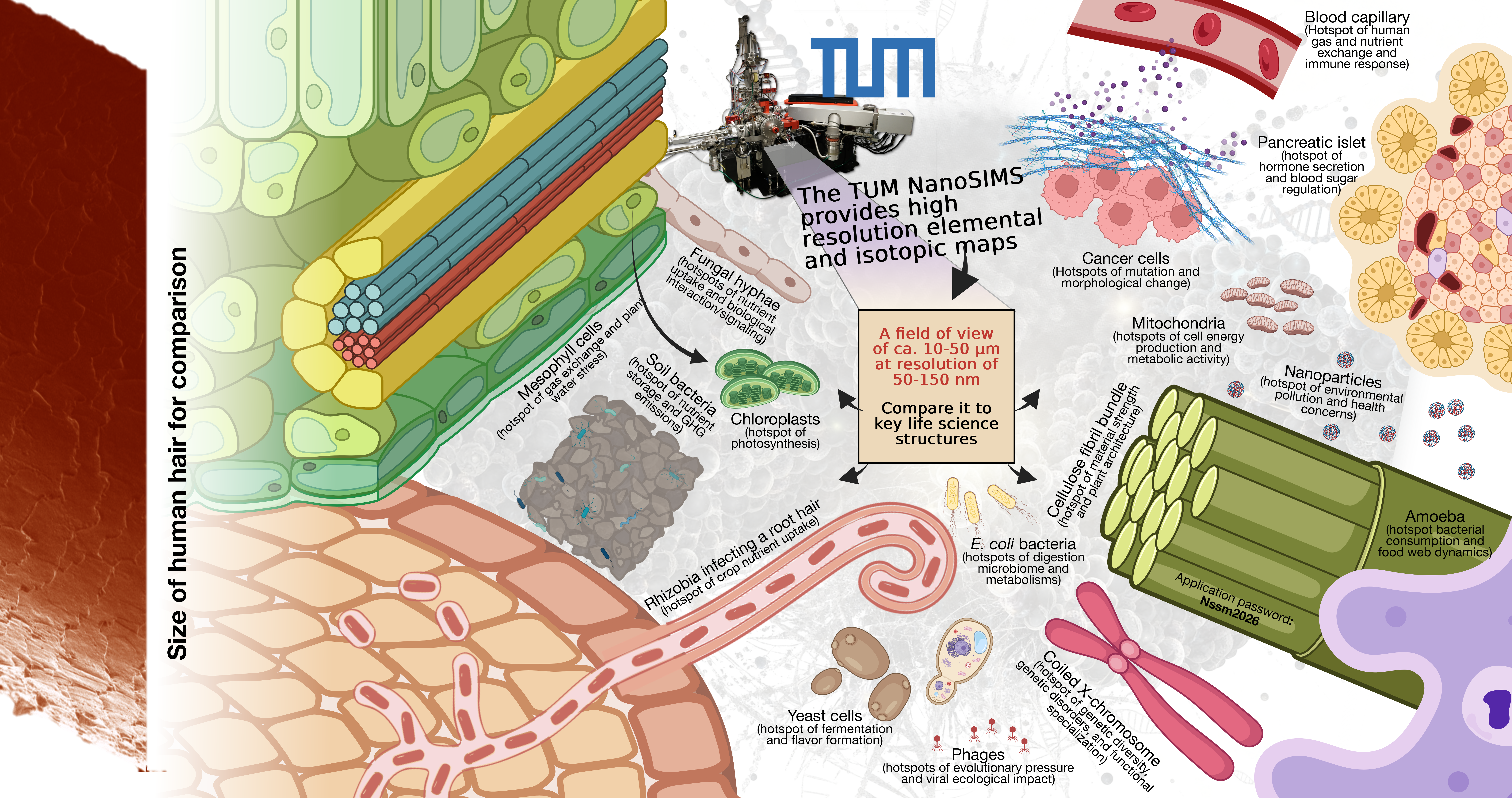
To get an impression of the microbial size scale of NanoSIMS, click here for a comparison to a human hair (left) and key life science objects.
Created in BioRender. Schweizer, S. (2025) BioRender.com/l0fh74f